


Hydrogen (H₂) extraction from ammonia through highly efficient thermocatalytic decomposition pathways
Technical University of Crete - Physical Chemistry Laboratory (PCCPlab)
The H2transition research project focuses on developing advanced nanocatalysts and integrated membrane‑reactor systems to enable efficient, high‑purity hydrogen production from ammonia. By combining catalyst nanoengineering with selective membrane separation, the project aims to optimize the entire conversion pathway and deliver next‑generation solutions for clean hydrogen recovery.
Ammonia represents one of the most promising carbon‑free molecular hydrogen carriers. Its decomposition produces no direct carbon‑containing by‑products, and the overall environmental footprint is determined solely by the upstream ammonia synthesis route and the energy used during the cracking process. This positions ammonia as a strategic medium for hydrogen storage, transport, and on‑demand energy generation across emerging clean‑energy infrastructures.
- Ammonia is one of the most promising carbon-free molecular hydrogen carriers.
- Ammonia decomposition generates no direct carbon-containing products; the overall carbon footprint depends on ammonia production and process-energy supply.
H2transition is a research initiative of the Technical University of Crete, supported by the Hellenic Foundation for Research and Innovation (H.F.R.I.), advancing innovative catalytic and reactor technologies for the evolving hydrogen economy.
About H₂transition
Turning ammonia into a practical hydrogen carrier
Hydrogen is expected to play an important role in the transition towards low-carbon energy systems. However, its storage and long-distance transport remain technically demanding because of its low volumetric energy density and the need for compression, liquefaction or dedicated infrastructure.
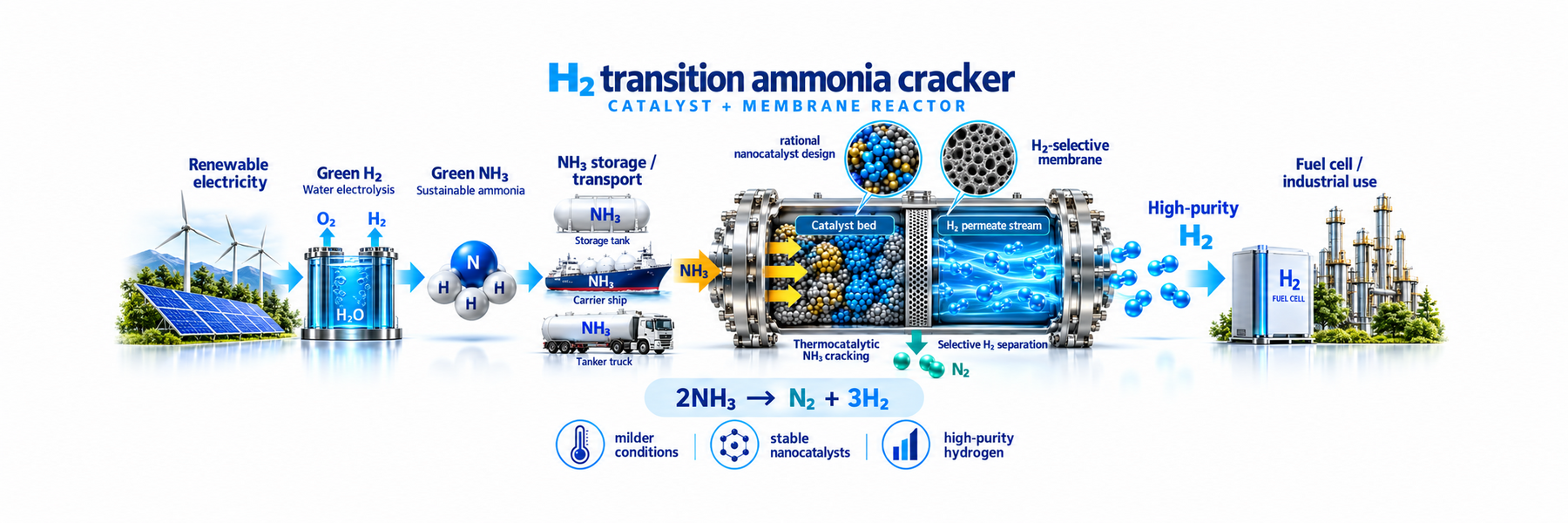
Ammonia (NH3) offers an attractive alternative as a hydrogen carrier because of its high hydrogen content, established production and distribution infrastructure, and comparatively convenient storage and transport conditions. H2transition investigates how hydrogen can be efficiently recovered from ammonia through thermocatalytic decomposition.
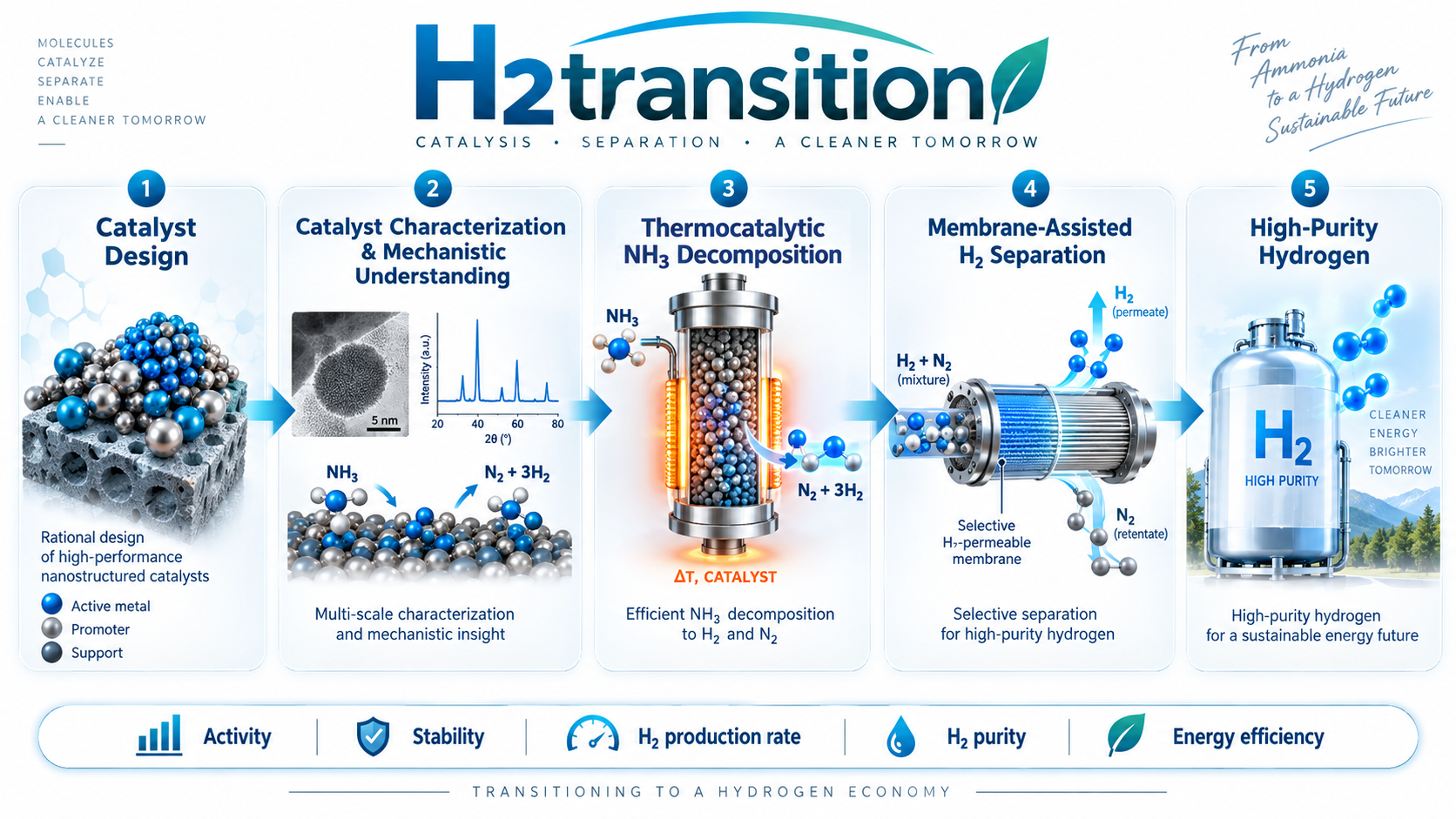
The project combines rational nanocatalyst design, advanced physicochemical characterization, reaction-mechanism studies and membrane-reactor engineering. Its objective is to develop active and stable catalytic systems for ammonia cracking and to integrate the most promising catalyst formulations with hydrogen-selective membrane concepts for efficient production of high-purity H2 under reduced operating and energy requirements.
Ammonia as a hydrogen carrier
Ammonia is a high‑density, easily stored and transported hydrogen carrier with mature global infrastructure and strong potential for clean‑energy applications.
17.8 wt% H₂
Ammonia contains a high fraction of hydrogen by mass, making it an attractive molecular hydrogen carrier.
Established infrastructure
Large-scale infrastructure already exists for ammonia production, storage, handling and global transportation.
High volumetric hydrogen density
Liquid ammonia enables compact storage and transportation of hydrogen compared with compressed gaseous H2.
Carbon-free molecule
NH3 contains no carbon and can support low-carbon hydrogen pathways when produced using renewable or low-carbon energy.
H₂transition Approach
Advanced Catalysts
Design and optimization of supported mono- and bimetallic catalyst formulations for enhanced ammonia decomposition at reduced temperatures.
Reaction Mechanisms
Identification of surface intermediates and structure–activity relationships using advanced characterization and in-situ spectroscopic techniques.
Catalyst Stability
Long-term testing, deactivation analysis and investigation of catalyst regeneration strategies under continuous operation.
Membrane Reactor Engineering
Integration of optimized catalysts with H₂-selective membranes for intensified ammonia conversion and simultaneous hydrogen separation.
Research Network
H2transition is connected with a broader research ecosystem in hydrogen, catalysis, advanced materials and sustainable-energy technologies. Scientific interactions and collaborative research activities involve researchers from the Institute of GeoEnergy – Foundation for Research and Technology – Hellas (FORTH), Chania, and the Institute of Nuclear & Radiological Sciences & Technology, Energy & Safety (INRASTES) of NCSR “Demokritos”, Athens.
Latest News
Project at a Glance
24 Months
April 2026 – March 2028
Project No. 29172
H.F.R.I.
€98,745
Total project budget
Host Institution
Technical University of Crete
Research Field
Environment and Energy / Hydrogen & Fuel Cells
Funding Acknowledgement

The research project is implemented in the framework of H.F.R.I call
“4th Call for H.F.R.I.’s Research Projects to Support Postdoctoral Researchers”
(H.F.R.I. Project Number: 29172).